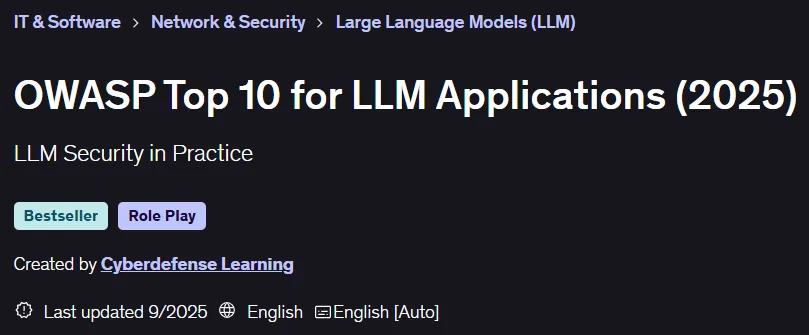

Description
OWASP Top 10 for LLM Applications (2025) course. This course examines critical security vulnerabilities and defensive strategies against generative AI threats, based on the authoritative OWASP framework. With models like GPT-4, Claude, and open-source models transforming the software industry, and their central role in systems like chatbots, coding assistants, and automated agents, it is essential to understand new security risks. These innovations have introduced complex, high-impact risks not seen in traditional architectures, including natural language-based attacks that are hidden in text documents and require direct access to the code to compromise the system. The most comprehensive, validated security framework for production AI systems, this course teaches developers and security professionals how to securely implement language-based model-based applications from design to deployment, whether using APIs from companies like OpenAI, Anthropic, the Hugging Face platform, or proprietary models. The course content goes beyond a superficial overview or threat list, and takes a practical, case-study-based approach to analyzing the reasons why modern applications fail and providing practical solutions for building resilient and secure systems.
What you will learn
- Understand the top 10 security risks in LLM-based programs, as defined by the OWASP LLM Top 10 (2025).
- Identify real-world vulnerabilities such as Prompt Injection, Model Poisoning, and Sensitive Data Disclosure, and how they manifest in production systems.
- Learn practical system-level defense strategies to protect LLM applications from abuse, overuse, and targeted attacks.
- Gain practical knowledge of emerging threats such as agent-based exploits, vector database leaks, and embedding inversion.
- Review best practices for secure prompt design, output filtering, plugin sandboxing, and rate limiting.
- Keeping up with AI-related regulations, compliance challenges, and upcoming security frameworks.
- Creating the mindset of a secure LLM architect; combining threat modeling, secure design, and proactive monitoring.
This course is suitable for people who:
- AI developers and engineers who are building or integrating LLMs into real-world applications.
- Security professionals seeking to understand how traditional threat models are evolving in the context of artificial intelligence.
- Product managers, architects, and technical leaders who want to make informed decisions about the secure deployment of LLMs.
- Startup founders and chief technology officers (CTOs) working on AI-based products who need to overcome risks before scaling.
- Artificial Intelligence/Machine Learning (AI/ML) developers working with GPT, Claude, or open source LLMs who want to understand and prevent security risks in their applications.
- Security engineers and application security (AppSec) teams who need to expand their threat models to include prompt injection, model abuse, and AI supply chain risks.
- Product managers and technical leaders who oversee products integrated with LLM, including chatbots, copilots, agents, and data retrieval-based systems.
- Software architects and solution designers who want to design secure LLM pipelines from scratch.
- DevOps and MLOps professionals responsible for deploying, monitoring, and securely releasing AI capabilities in the cloud.
- AI startup founders, CTOs, and engineering managers who want to avoid costly mistakes in scaling their LLM products.
- Security researchers and Red Teams interested in exploring new attack surfaces introduced by generative AI tools.
- Regulatory, privacy, or risk teams trying to understand where LLM behavior intersects with legal and compliance obligations.
Course details
- Publisher: Udemy
- Instructor: Cyberdefense Learning
- Training level: Beginner to advanced
- Training duration: 6 hours and 5 minutes
- Number of lessons: 72
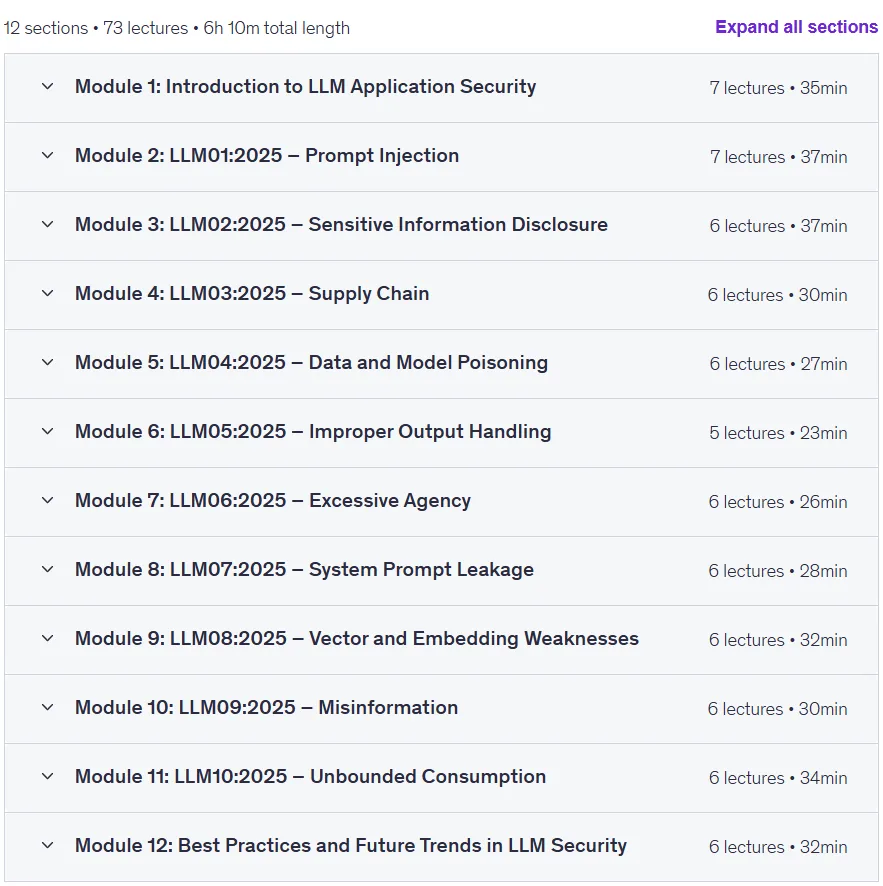
Course syllabus as of 2025/9
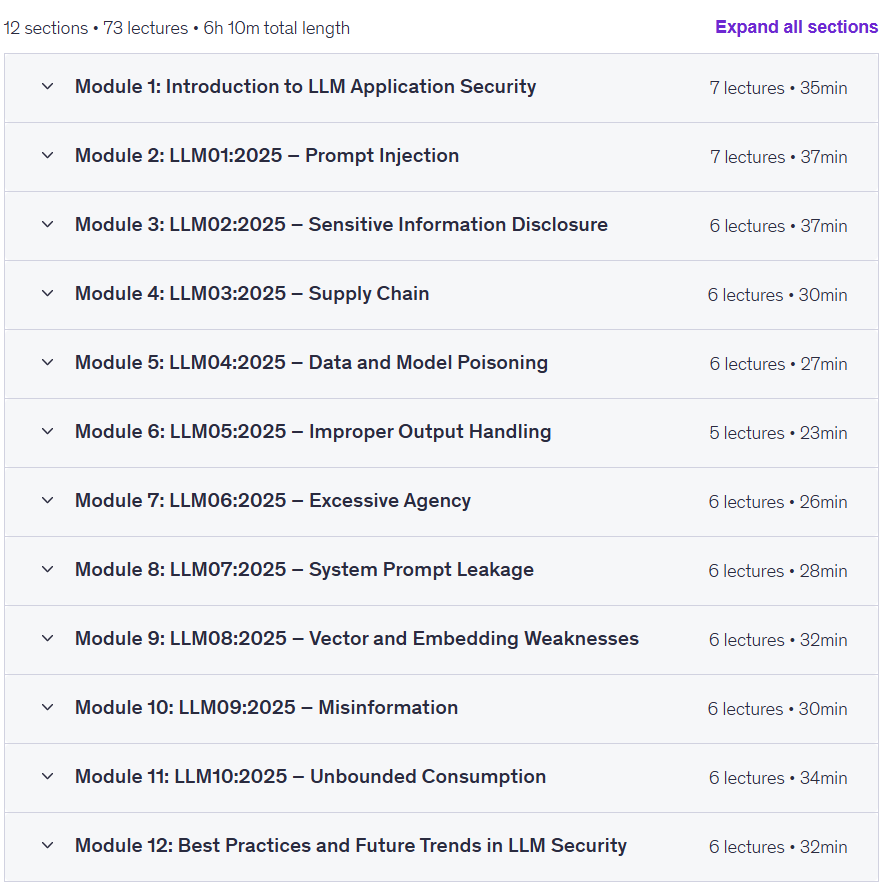
OWASP Top 10 for LLM Applications (2025) Course Prerequisites
- No deep security background is required — just basic familiarity with how LLM applications work.
- Ideal for developers, architects, product managers, and AI engineers working with or integrating large language models.
- Some understanding of prompts, APIs, or tools like GPT, LangChain, or vector databases is helpful — but not mandatory.
- Curiosity about LLM risks and a desire to build secure AI systems is all you really need.
- Comfort with reading or writing basic prompt examples, or experience using LLMs like ChatGPT, Claude, or similar tools.
- A general understanding of how software applications interact with APIs or user input will make concepts easier to grasp.
Course images

Sample course video
Installation Guide
After Extract, view with your favorite player.
Subtitles: None
Quality: 720p
Download link
Downloadly
Rapidgator link
File(s) password: www.downloadly.ir
File size
3.6 GB