
Descriptions
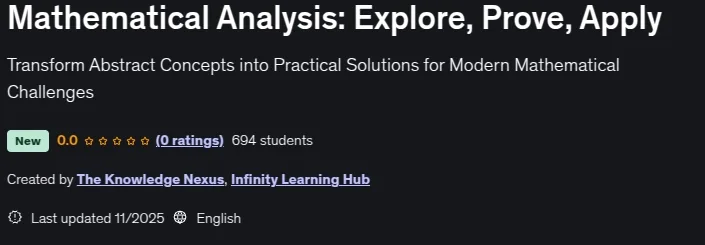
Mathematical Analysis: Explore, Prove, Apply, This course equips learners with the tools to understand and apply advanced concepts in topology, differentiation, manifolds, and dynamical systems. It bridges the gap between abstract theory and practical applications, preparing students for research, innovation, and interdisciplinary work in science, engineering, and technology. In today’s world, mathematics is not just about numbers—it is the language of modern science and technology. Whether you aim to model complex systems, optimize processes, or develop cutting-edge algorithms, the ability to think rigorously and abstractly is essential. This course provides that foundation by focusing on conceptual understanding, rigorous reasoning, and practical application. You will not only learn how to solve problems but also why the solutions work and how to adapt these methods to new challenges. By the end of the course, you will have the confidence and skills to tackle advanced mathematical problems, contribute to interdisciplinary projects, and pursue research or professional roles that demand analytical excellence.
What you’ll learn
- Model and solve complex real-world problems using advanced mathematical analysis, bridging theory with practical applications in science and engineering.
- Develop rigorous reasoning and proof skills to justify solutions and communicate ideas with precision and clarity.
- Integrate multiple mathematical frameworks—topology, calculus, and geometry—to analyze multidimensional systems and dynamic processes.
- Apply analytical and computational tools to predict system behavior, optimize solutions, and implement methods in modern software environments.
- Cultivate transferable problem-solving and critical thinking skills for research, interdisciplinary collaboration, and emerging technologies.
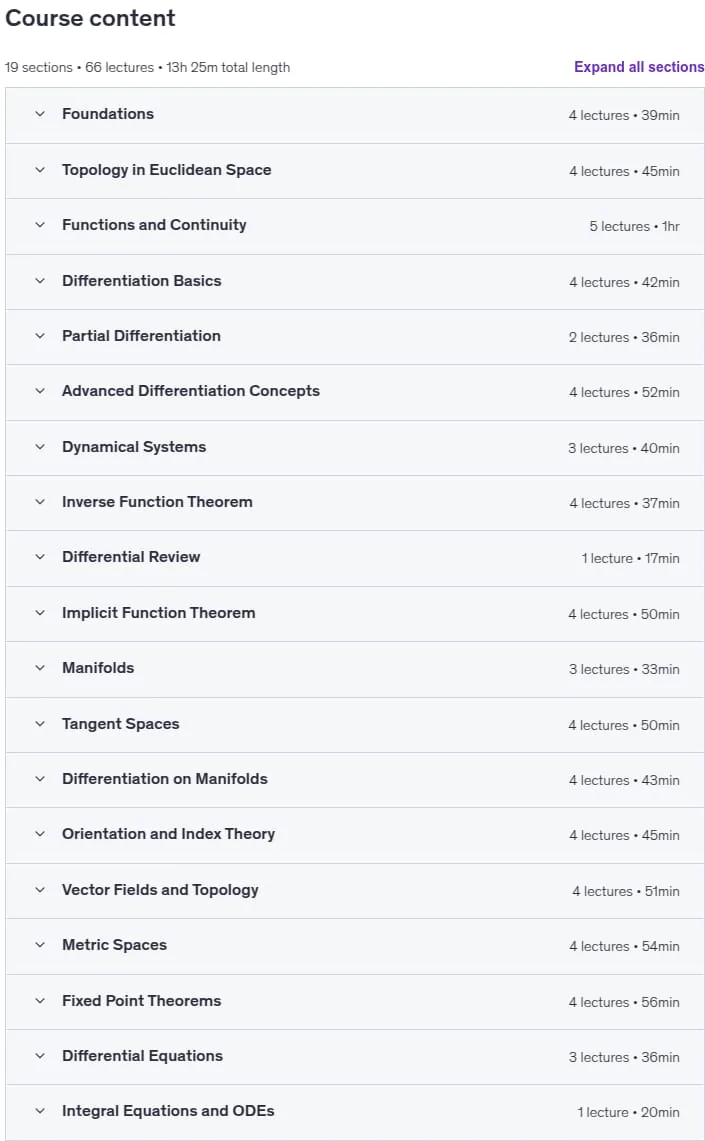
- Analyze and classify topological properties of sets in Euclidean space, including compactness and connectedness.
- Evaluate limits and continuity for multivariable functions and apply continuity theorems in problem-solving.
- Compute and interpret derivatives for functions of several variables, including using the chain rule in complex scenarios.
- Apply partial differentiation techniques to solve problems involving multivariable functions and physical models.
- Construct and analyze vector fields and determine integral curves for dynamical systems.
- Use the inverse and implicit function theorems to solve nonlinear systems and justify local behavior of functions.
- Model and interpret manifolds and compute tangent spaces for applications in geometry and physics.
- Calculate Jacobians and differential maps to understand transformations and their effect on orientation and volume.
- Apply orientation and index theory to study vector fields and topological invariants in practical contexts.
- Work with metric spaces to rigorously analyze convergence, completeness, and continuity in abstract settings.
- Prove existence and uniqueness of solutions using fixed point theorems for differential and integral equations.
- Solve ordinary differential equations (ODEs) using analytical and approximation methods relevant to real-world systems.
- Formulate and solve integral equations encountered in physics and engineering applications.
- Translate theoretical concepts into applied models for optimization, control systems, and computational simulations.
- Develop rigorous proofs and logical arguments to validate mathematical results and communicate solutions effectively.
Who this course is for
- Undergraduate or graduate students in mathematics, physics, engineering, or computer science.
- Learners preparing for advanced courses in functional analysis, differential geometry, or dynamical systems.
- Professionals or researchers needing rigorous foundations for applied fields like data science, machine learning, or control theory.
- Anyone aiming to strengthen problem-solving skills in theoretical and applied mathematics.
Specificatoin of Mathematical Analysis: Explore, Prove, Apply
- Publisher : Udemy
- Teacher : The Knowledge Nexus , Infinity Learning Hub
- Language : English
- Level : Expert
- Number of Course : 66
- Duration : 13 hours and 25 minutes
Content of Mathematical Analysis: Explore, Prove, Apply

Requirements
- Familiarity with matrices, determinants, vector spaces, and transformations.
- Understanding of limits, derivatives, integrals, and multivariable calculus.
- Ability to work with rigorous proofs and epsilon-delta definitions.
- Knowledge of first-order and simple second-order ODEs.
- Comfort with abstract reasoning and proof-writing.
Pictures
Sample Clip
Installation Guide
Extract the files and watch with your favorite player
Subtitle : English
Quality: 1080p
Download Links
Downloadly
Rapidgator
Password file(s): www.downloadly.ir
File size
20.65 GB