Description
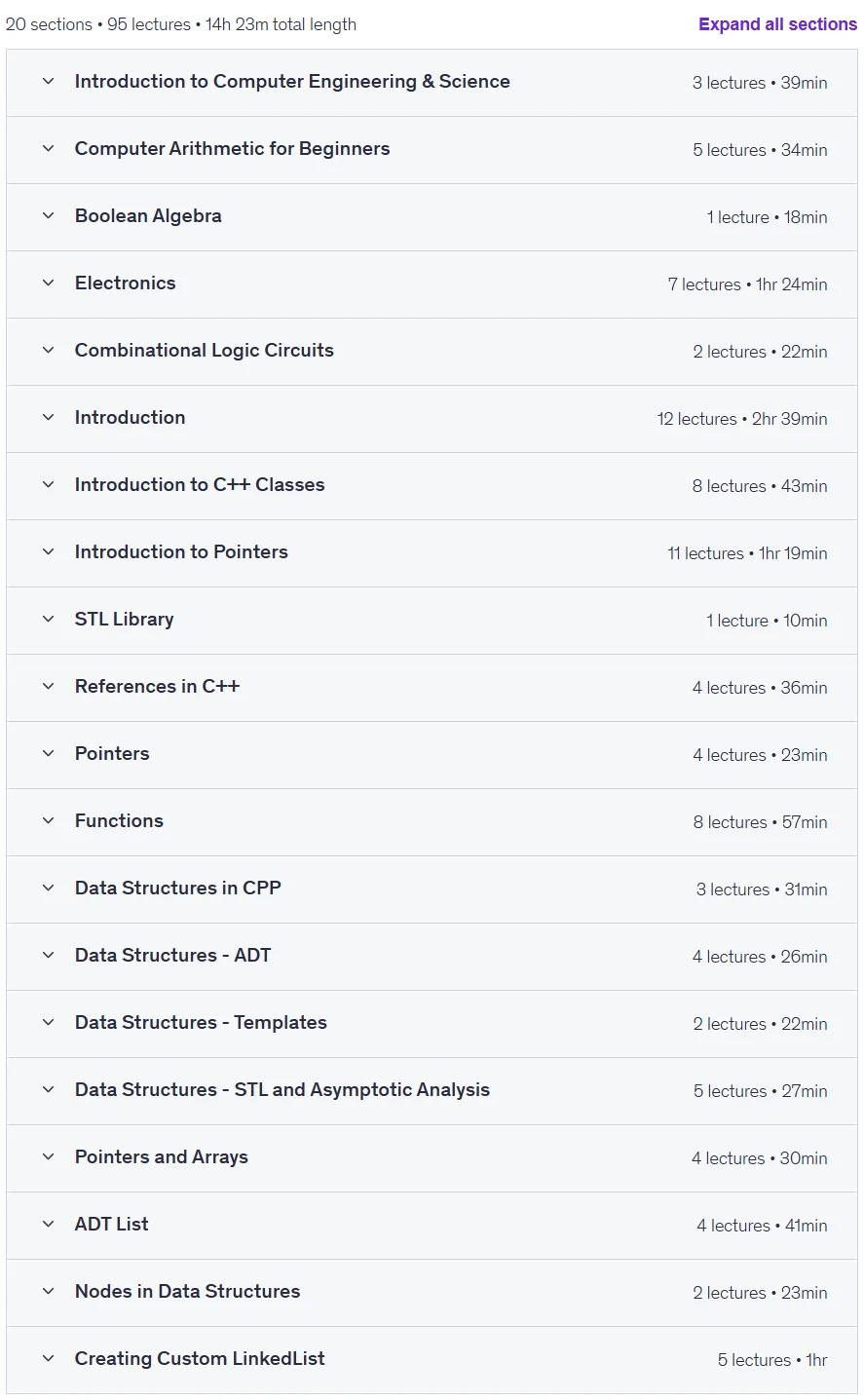
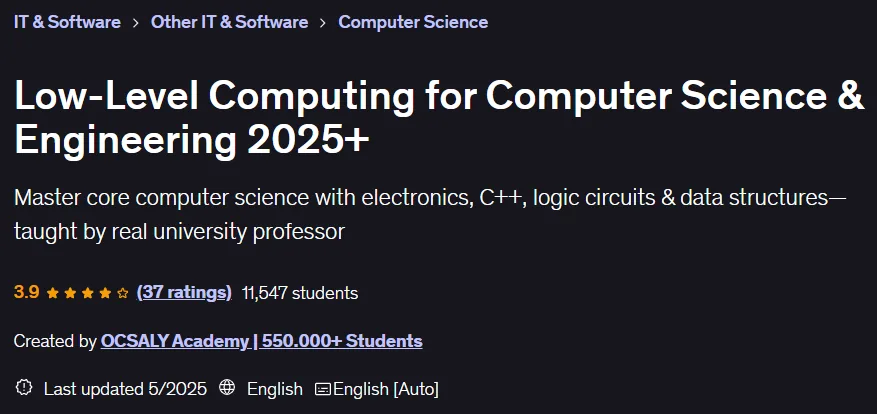
Low-Level Computing for Computer Science & Engineering 2025+. This comprehensive academic course teaches participants how computers work at the most basic level, from transistors and logic circuits to memory management with C++. Taught by experienced experts, the course provides the essential foundation for a thorough understanding of computing, whether for students or software engineers. With over 16 hours of condensed video content, this course is an in-depth survey that covers practical, low-level concepts that are often overlooked. Participants begin their educational journey by understanding how computers communicate and progress to computer arithmetic, Boolean algebra, electronic principles, logic circuits, and finally C++ programming, data structures, memory management, and software engineering methodologies. This course shows how transistors provide computing power, how MOSFETs work inside processors, how pointers manage memory, and how modern software is built on physical hardware. Using hands-on projects, diagrams, code reviews, and step-by-step explanations, complete clarity is ensured for all learners. Based on a real university curriculum, unlike many other courses, this course integrates hardware and software, is structured for beginners but also has depth for advanced learners, includes practical C++ programming and memory management, and teaches modern tools and concepts used in real-world engineering. This course provides a solid foundation for careers in systems programming, embedded systems development, cybersecurity, or for anyone seeking a fundamental understanding of computers.
What you will learn
- Understanding how computers communicate, calculate, and perform operations at the lowest level.
- Learn the basics of computer arithmetic, including signed and unsigned binary operations.
- Mastery of Boolean algebra and logic used in digital computing and circuit design.
- Explore basic electronics concepts such as capacitors, inductors, and power consumption in hardware.
- Analyze how transistors, MOSFETs, and CMOS switches work in modern CPUs.
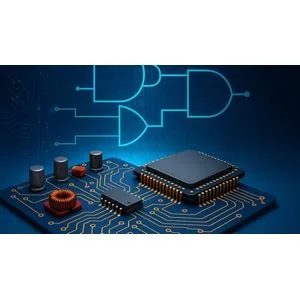
- Construct and understand logic circuits, including adders and combinational logic.
- Gain in-depth skills in C++ programming, including variables, loops, Enums, and data types.
- Learn memory management using pointers, arrays, references, and dynamic memory allocation.
- Working with data structures such as Abstract Data Types (ADTs), Linked Lists, Vectors, and Templates in real-world scenarios.
This course is suitable for people who:
- Computer Science and Engineering Students: This course provides a very strong foundation in low-level computing that most college degrees rarely address. Participants will gain real insight into how code interacts with hardware, which will set them apart.
- Aspiring software developers and systems programmers: People who want to build powerful, efficient software that works closely with the hardware. This course teaches how memory, processors, and C++ really work, setting them apart from superficial developers.
- Electronics and Embedded Systems Enthusiasts: If someone is fascinated by how computers work at the hardware level – transistors, circuits, and logic gates – this course will provide the skills to turn curiosity into confidence.
- Self-taught programmers and career changers: People who have learned to code but want to understand what goes on behind the scenes. This course bridges the gap between coding and computer science, helping them think like an engineer, not just a coder.
Course details
- Publisher: Udemy
- Instructor: OCSALY Academy | 480,000+ Students
- Training level: Beginner to advanced
- Training duration: 14 hours and 23 minutes
- Number of lessons: 95
Course headings

Prerequisites for the Low-Level Computing for Computer Science & Engineering 2025+ course
- No prior knowledge required – this course starts from absolute basics and builds up gradually.
- A computer or laptop to follow along with the coding and software demonstrations.
- Motivation to learn how computers really work, from hardware to high-level programming.
- Curiosity and patience to explore both electronics and C++ step by step.
Course images

Sample course video
Installation Guide
After Extract, view with your favorite player.
Subtitles: None
Quality: 720p
Download link
Downloadly
Rapidgator link
File(s) password: www.downloadly.ir
File size
7.3 GB