
Description
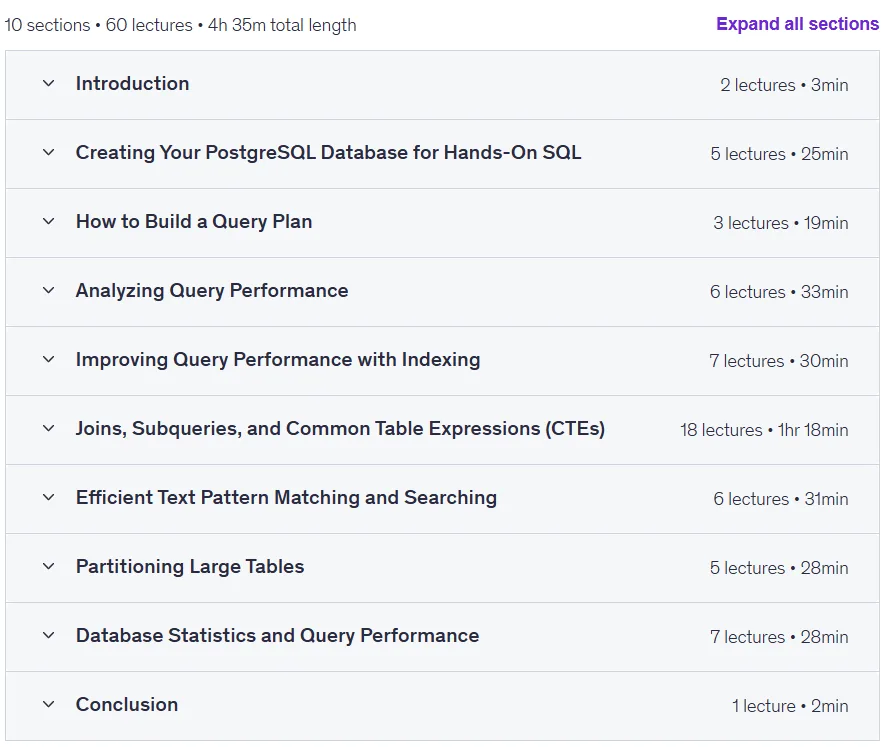
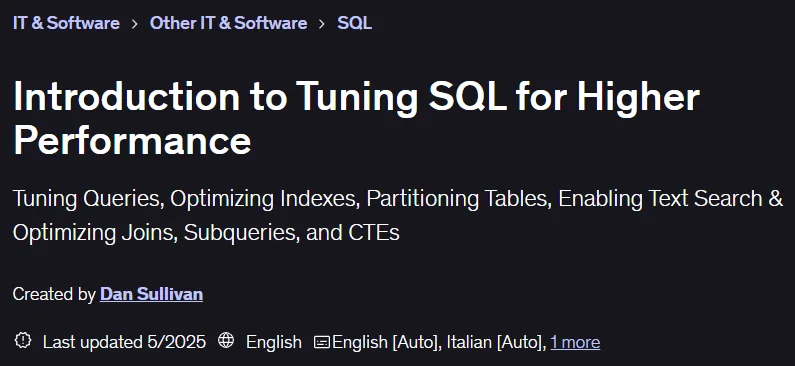
Introduction to Tuning SQL for Higher Performance. This course teaches the principles of optimizing and tuning SQL queries to increase execution speed and improve database performance. This course is designed for those who are familiar with writing SQL but want to make their queries more efficient. This course explains the principles of SQL performance and optimization techniques, building on participants’ existing knowledge, and addresses SQL query planning and performance evaluation. Understanding the database planning is essential for analyzing and tuning queries; therefore, this course teaches how query plan builders work, including how to implement basic operations such as retrieving data, joining tables, and filtering results using various plan nodes. Participants learn how to read execution plans, compare cost calculations, and evaluate alternative implementations for their queries. Through hands-on exercises, various query patterns are analyzed and the impact of their rewriting on performance is observed. Advanced optimization techniques include indexing strategies such as covering, full-text, and phrase indexes, examining join algorithms with real-world scenarios, optimizing related subqueries and complex window functions, as well as using materialized views and common table expressions for query performance. Additionally, pattern matching techniques including regular expressions and full-text search are taught, and the performance implications of GiST, GIN, and SP-GiST index types are covered. For enterprise-level scenarios, implementing partitioning strategies for large tables, time-series optimization techniques for IoT data, and full-text search in large-scale applications are explored. Tools and techniques for monitoring and tuning ongoing performance are also provided, such as advanced use of pg_stat views, tuning autovacuum, and maintaining statistics on tables. During the course, work will be done with sales database datasets and an IoT vehicle sensor system with millions of daily records, and practical exercises will enable the application of theoretical knowledge to practical scenarios. By the end, participants will have the skills to analyze complex queries and the knowledge to make informed decisions about database performance trade-offs in production systems.
What you will learn
- Generate and understand query execution plans.
- Define indexes and partitioning strategies to improve query performance.
- Choose optimal methods for implementing business logic using joins, subqueries, and common table expressions (CTEs).
- Monitor database statistics to improve query performance.
This course is suitable for people who:
- Data analysts.
- Reporters.
- Developers who work with relational databases.
- Database administrators.
- Data engineers.
- ETL developers.
- Data modelers.
- Data architects.
- Business analysts.
- SQL users.
- Database users.
Course details
- Publisher: Udemy
- Instructor: Dan Sullivan
- Training level: Beginner to advanced
- Training duration: 4 hours and 35 minutes
- Number of lessons: 60
Course headings

Prerequisites for the Introduction to Tuning SQL for Higher Performance course
- Some experience with SQL SELECT statements
Course images

Sample course video
Installation Guide
After Extract, view with your favorite player.
Subtitles: English
Quality: 1080p
Download link
Downloadly
Rapidgator link
File(s) password: www.downloadly.ir
File size
1.1 GB