
Description
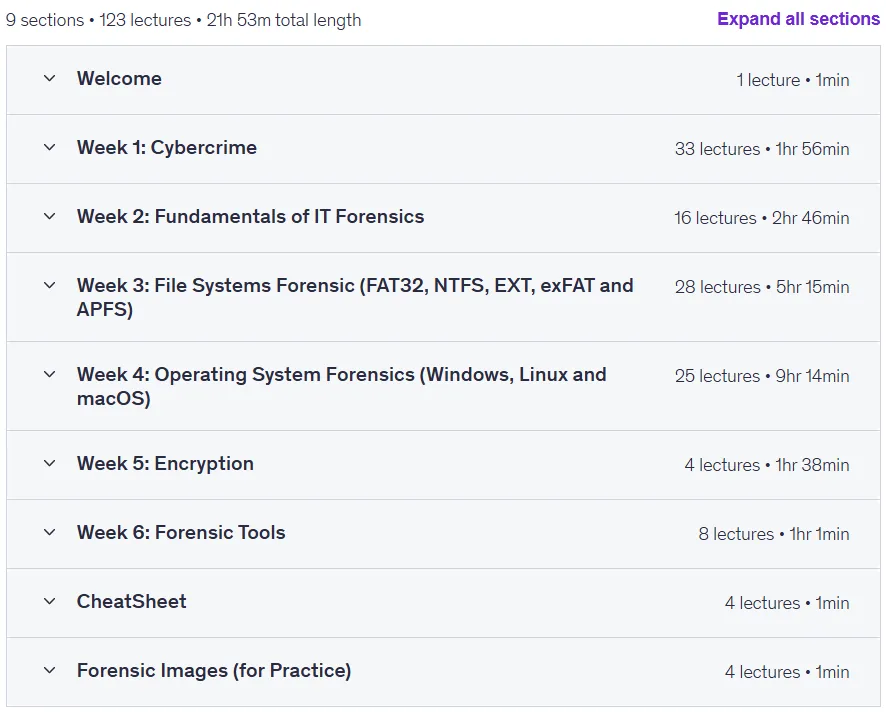
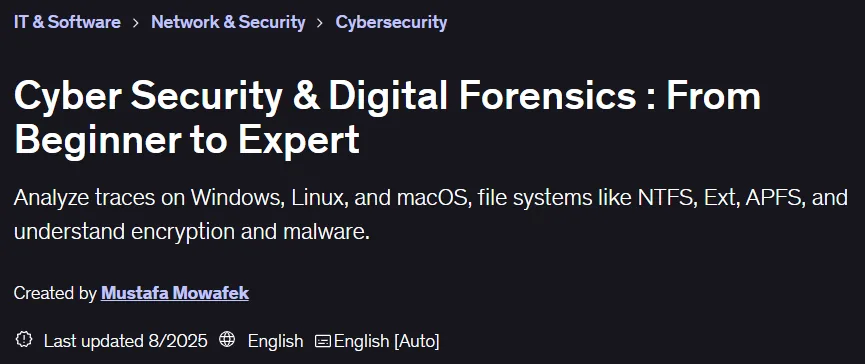
Cyber Security & Digital Forensics: From Beginner to Expert. This course provides a comprehensive learning path from fundamentals to expert levels in the fields of IT, digital forensics, and cybersecurity. The course begins with a thorough introduction to how malware, including viruses, worms, and trojans, works and provides the insights needed to understand and prevent attacks such as phishing, DDoS attacks, man-in-the-middle attacks, and impersonation. The course’s primary focus is on analyzing operating system artifacts in Windows, Linux, and Mac environments, where participants gain practical skills to identify and evaluate digital footprints such as registry artifacts, event logs, user activities, USB footprints, cloud data, as well as analyze system files such as pagefile.sys and volume shadow copies. Another part of the course covers advanced analysis of file systems, including NTFS, examining the boot sector structure, master file table, key features, and alternate data streams. It also covers FAT, exFAT, EXT, and APFS file systems to provide a comprehensive understanding of storage formats. Other key parts of the course include an introduction to legal frameworks related to cybercrime and training in the secure configuration of encryption tools such as BitLocker, VeraCrypt, and FileVault. By the end, learners will have the ability to analyze operating systems, identify artifacts, detect threats, and implement advanced security solutions, and this path is transformed into a practical and complete experience through the use of practical exercises, reference guides, and exams.
What you will learn
- Fundamentals of Digital Criminology:
- Duties, requirements, and methods for securing and analyzing digital evidence.
- Essential knowledge of hardware and software.
- DIN EN ISO/IEC 27037 standard:
- Guidelines for identifying, collecting, acquiring, and preserving digital evidence in criminological investigations.
- Operating system analysis:
- Forensic examination of artifacts on Windows, Linux, and macOS systems, including registry, event logs, and user activity.
- Focus on file systems:
- In-depth knowledge of NTFS, exFAT, APFS, and FAT.
- Understanding sectors, clusters, and the Master File Table (MFT).
- Tools and practice:
- Using forensic tools to analyze digital systems and perform independent disk inspections.
- Cybersecurity and prevention:
- Understand malware such as viruses, worms, and Trojan horses, and employ effective prevention strategies and secure encryption.
- Legal basis:
- An overview of cybercrime laws, including data espionage and computer fraud.
This course is suitable for people who:
- IT Forensic Expert: To examine digital evidence in legal and criminal cases.
- IT Security Analyst: To identify and mitigate security incidents in companies and organizations.
- System Administrators: To increase understanding of operating system artifacts and secure forensic data.
- Cybercrime Investigator: To deepen knowledge about legal frameworks and investigative procedures.
- IT Auditors: To assess IT systems and processes for security and compliance.
- Lawyers: To improve advice and representation of clients in cybercrime cases.
- Law Enforcement Officers: To conduct targeted cybercrime investigations and secure digital evidence.
- Companies: To train IT professionals to improve security standards and incident analysis.
- IT Professionals: To deepen knowledge in IT forensics and cybersecurity to better respond to security incidents.
- Compliance Officers: To ensure legal compliance in the management of data and digital evidence.
- Computer Science Students: To prepare for careers in IT security and criminology.
- Hobby IT Enthusiasts: To learn about IT criminology and a basic understanding of cybersecurity.
Course details
- Publisher: Udemy
- Instructor: Mustafa Mowafek
- Training level: Beginner to advanced
- Training duration: 21 hours and 53 minutes
- Number of lessons: 123
Course headings

Prerequisites for the Cyber Security & Digital Forensics: From Beginner to Expert course
- Basic IT Knowledge: Understanding computer architecture and fundamental mathematical concepts.
Course images

Sample course video
Installation Guide
After Extract, view with your favorite player.
Subtitles: None
Quality: 720p
Download link
Downloadly
Rapidgator link
File(s) password: www.downloadly.ir
File size
8.6 GB