Description
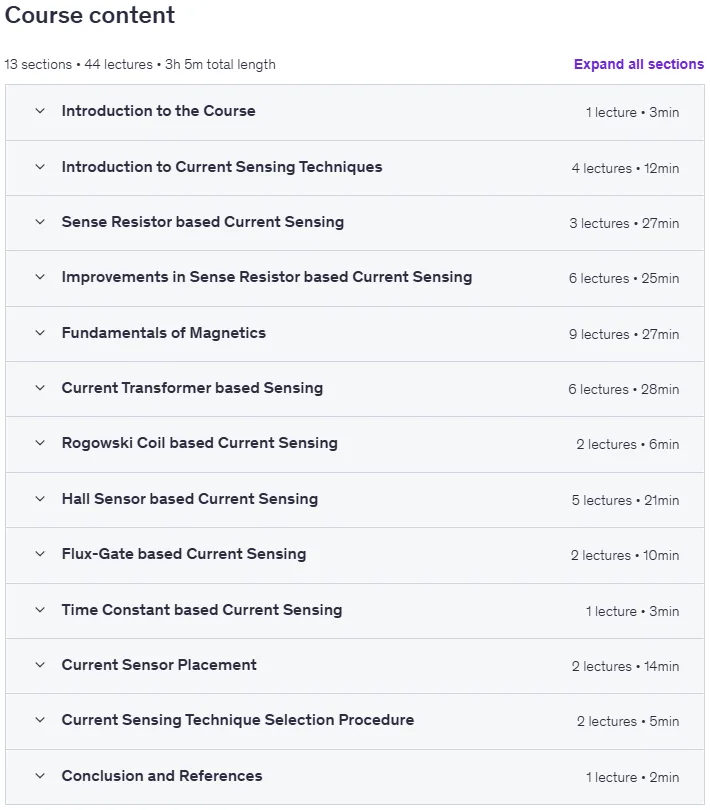
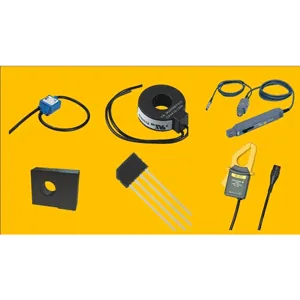
Current Sensing Techniques in Power Electronics is a course on accurate current measurement and monitoring in power electronics systems published by Udemy Online Academy. This is a specialized course that examines how to accurately measure and monitor current in power electronics systems, an essential skill for designing efficient converters, inverters, motor drives, and protection circuits. The course introduces learners to a wide range of sensing techniques—such as shunt resistors, Hall effect sensors, current transformers, Rogowski coils, and isolated sensing techniques—and explains how each method works, where it is used, and its drawbacks. Students learn how to select the appropriate sensing approach based on accuracy, bandwidth, isolation requirements, thermal constraints, and cost.
Key points include understanding the principles of various current sensing methods, comparing shunt and isolated sensing approaches, analyzing accuracy and bandwidth limitations, implementing Hall-effect and transformer-based sensors, applying Rogowski coils for high-frequency measurements, designing appropriate circuits for signal conditioning, reducing noise and electromagnetic interference in the measurement paths, selecting sensors based on application requirements, integrating sensor outputs with digital controllers, and ensuring safe and reliable current monitoring in power electronics systems. The course also covers signal conditioning, noise reduction, PCB design considerations, and integration with microcontrollers or digital control systems. In the end, learners will gain a solid foundation for building reliable, high-performance power electronics designs.
What you will learn in Current Sensing Techniques in Power Electronics:
- Importance of Current Information, Sensing vs. Measurement, Voltage Sensing vs. Current Sensing, Current Sensing Techniques
- Introduction to Sense Resistor, Sense Resistor Selection Parameters, Design Example
- Kelvin Sensor or 4-Terminal Sensing, PCB Trace as Sense Resistor, Lead Frame as Sense Resistor
- MOSFET Channel Resistance as Sense Resistor, DCR Inductor as Sense Resistor, Sense-FET Current Sensing Technology
- Introduction to Magnetic Circuits, Magnetic Circuit Terminology, Ampere’s Law, Faraday’s Law, Relationship Between Electric and Magnetic Field
- Volt-Second Equilibrium, Inductance and Its Energy Storage, Area Product, Introduction to Transformers
- And…
Course specifications
Publisher: Udemy
Instructors: Siri Subrahmanyam Vadlamani
Language: English
Level: Introductory to Advanced
Number of Lessons: 44
Duration: 3 hours and 5 minutes
Course topics

Current Sensing Techniques in Power Electronics Prerequisites
Basic Understanding of Electrical Engineering Principles – Voltage, Current, Power, etc.
Circuit Analysis using KCL, KVL, Linear Circuits
Basics of Algebra
Genuine Interest in the Subject Matter
Pictures

Current Sensing Techniques in Power Electronics introduction video
Installation guide
After Extract, watch with your favorite Player.
Subtitle: None
Quality: 720p
Downloadly link
Rapidgator link
File password (s): www.downloadly.ir
Size
812 MB