
Description
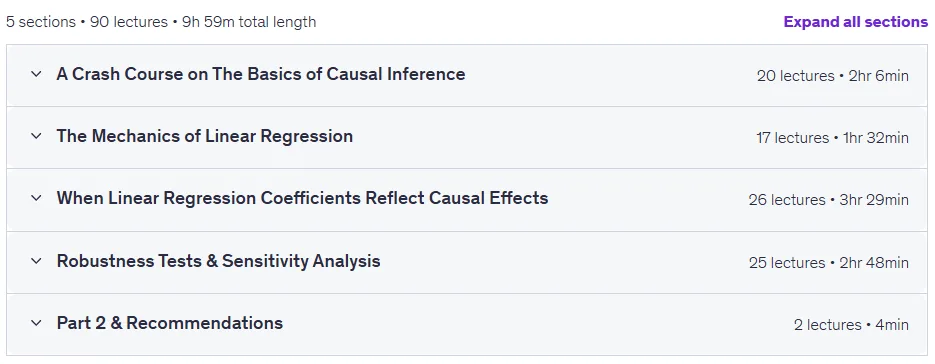
Causal Inference with Linear Regression: A Modern Approach. This course examines the proper use of linear regression for causal inference in a scientific manner. Despite its widespread use, linear regression is often misinterpreted when discussing causal inference, and its coefficients are often mistaken for causal effects. Classic assumptions such as exogenousity are often repeated, but they are difficult for many analysts to grasp in practice. This course aims to fill existing educational gaps by clearly demonstrating under what conditions linear regression coefficients can indicate causal effects. The course is structured in four parts: Part I covers the fundamental concepts of causal inference. Part II explores the mechanical details of regression and the ordinary least squares method. Part III introduces linear structural models, specifies the parameters we look for in the search for causal effects, and explains the precise conditions for retrieving them. Finally, the fourth section focuses on designing robustness tests and sensitivity analysis to increase confidence in the results. The course content is based on the work of prominent researchers such as Judah Perl and Angrist and Pichke, and in addition to a solid theoretical foundation, it is designed for practical use and includes numerous programming examples in Python.
What you will learn
- How to estimate total and direct causal effects using a linear regression model.
- Identifying when linear regression coefficients can or cannot be interpreted causally.
- Deep understanding of the concept of linear structural models and their related parameters.
- Identify key differences between linear structural equations and ordinary linear regression equations.
- How to perform robustness tests and sensitivity analysis on estimated causal effects.
- Ability to work with causal graphs, graphical metrics, and specialized DAGitty tools.
This course is suitable for people who:
- All professionals looking to learn how to properly and scientifically use linear regression for causal analyses.
- Data scientists and analysts who want to go beyond mere statistical interpretations and seek to uncover cause-and-effect relationships in data.
- Researchers who are familiar with the basics of probability theory, linear algebra, and statistics and intend to advance their knowledge.
- Machine learning enthusiasts who want to base their models on causal reasoning.
- Business analysts who are responsible for defending the results of their analyses to managers.
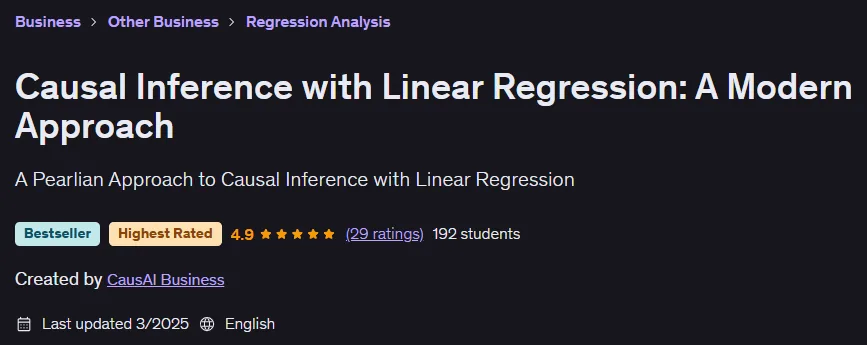
Course Description: Causal Inference with Linear Regression: A Modern Approach
- Publisher: Udemy
- Instructor: CausAI Business
- Training level: Beginner to advanced
- Training duration: 9 hours and 59 minutes
- Number of lessons: 90
Course headings

Prerequisites for the course Causal Inference with Linear Regression: A Modern Approach
- Basic knowledge of Probability Theory, Linear Algebra & Statistics (Python is beneficial)
Course images

Sample course video
Installation Guide
After Extract, view with your favorite player.
Subtitles: English
Quality: 720p
Download link
Rapidgator link
File(s) password: www.downloadly.ir
File size
2.07 GB