

Description
Generative Analysis: The Power of Generative AI for Object-Oriented Software Engineering with UML. This course explores the application of generative AI and the UML language to systems analysis and improve software engineering quality. Building on large language models such as ChatGPT, the focus shifts from coding to systems analysis, introducing “generative analysis” as a systematic approach to bridging the gap between business analysis and software engineering. The goal is to teach you how to define requirements at the optimal level of abstraction to generate high-quality inputs for AI and achieve reliable outputs. The course covers how to choose the right abstraction levels and use UML in an AI-powered pipeline, and includes techniques such as textual modeling to create narrative documentation and M++ to validate AI outputs with rigorous language patterns and multi-valued logic. It also teaches methods for reducing errors in AI models and guiding code generation through visual models. A practical project called OLAS is followed throughout the course, which includes the stages of prompt engineering, concept mapping, use case modeling, architectural design, and requirements processing. This approach helps organizations and engineers achieve faster analysis, safer code generation, and more efficient project delivery, with the principle that AI does not replace the analyst, but rather enhances his or her ability to manage software complexity.
What you will learn
- Using generative artificial intelligence alongside UML to generate, validate, and iterate software engineering documentation and artifacts.
- Identify and work at the optimal level of abstraction to perform accurate analysis and code generation using large language models.
- Using Literate Modeling techniques and M++ language to accurately record requirements and review AI outputs to prevent errors.
- Use mind and concept mapping to quickly organize ideas and clarify relationships between different components of the system.
- Transform informal conversations and meetings into formal, structured documentation that can be understood by artificial intelligence.
- Designing a logical and layered system architecture and evaluating the advantages and disadvantages of different design patterns.
- Professional use case modeling to guide the rapid prototyping process with the help of artificial intelligence.
- Refine vague requirements and transform them into testable and precise statements using predicate functions.
This course is suitable for people who:
- Software engineers, developers, and quality assurance (QA) analysts who plan to integrate generative AI into their daily workflow.
- Business analysts, product managers, and technical leaders who are responsible for eliciting requirements and initial system design.
- Solution architects and systems analysts who are tasked with modeling complex software domains using UML.
- Experts who are looking for scientific methods to reduce AI errors and increase the accuracy of code generation.
Course details
- Publisher: Oreilly
- Instructor: Jim Arlow
- Education level: Intermediate
- Training duration: 6 hours and 21 minutes
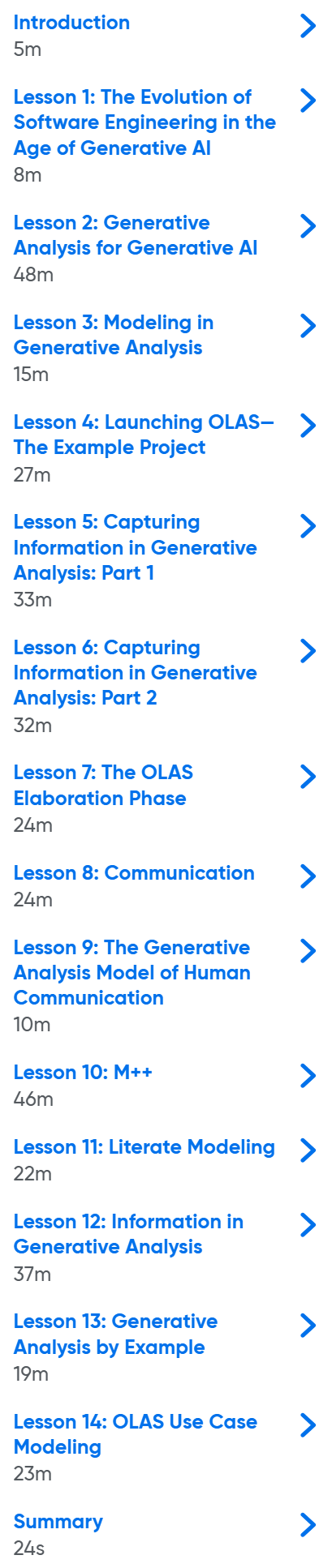
Course headings
Course prerequisites
- Basic knowledge of UML and object-oriented concepts
- Familiarity with programming and the software development lifecycle
- Comfort using Generative AI tools (eg, ChatGPT, Copilot, Gemini) for prompts and code assistance
Course images

Sample course video
Installation Guide
After Extract, view with your favorite player.
Subtitles: English
Quality: 720p
Download link
Downloadly
Rapidgator link
File(s) password: www.downloadly.ir
File size
4.8 GB