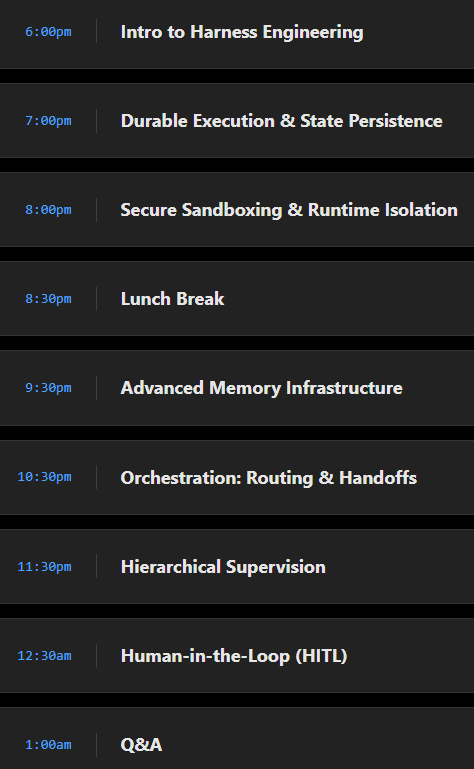
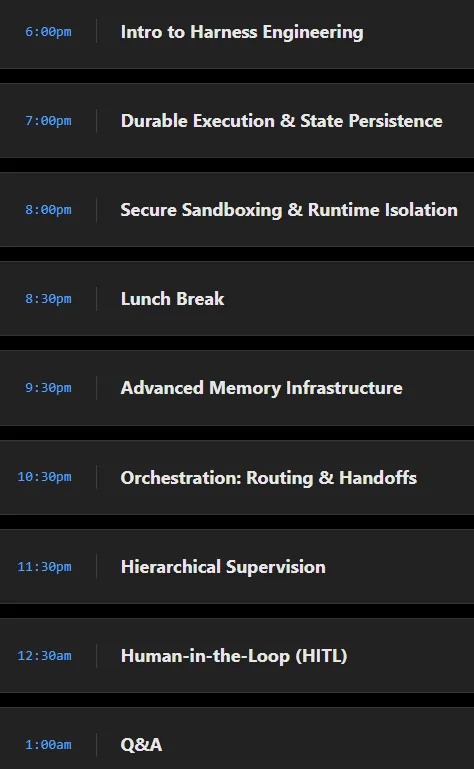
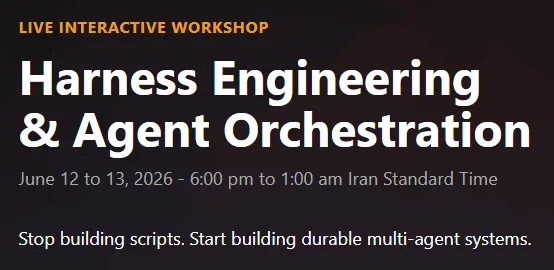
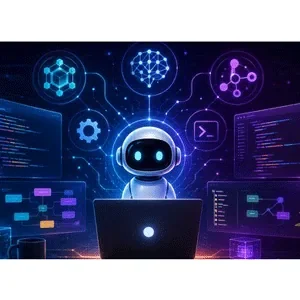
Harness Engineering & Agent Orchestration Course. This course explores advanced infrastructure and architectural patterns for designing, managing, and orchestrating robust, fault-tolerant multi-agent systems using TypeScript and Node.js. This intensive, one-day workshop is designed to move beyond simple scripts and rudimentary chat interfaces to focus on the critical infrastructure required to reliably run intelligent agents in real-world environments. The course examines the architecture of the peripheral systems that provide a large language model (LLM) with the necessary memory, tools, and security frameworks. This protection and management structure is known as the Agent Harness, which injects information context, observability, and safety constraints. Rather than focusing on a single, large project, each lesson in the workshop introduces and explores a completely new, standalone architectural pattern. The instructor will code each concept live using TypeScript and Node.js to fully demonstrate how to implement them in practice. In the process, students will learn how to use Durable Execution capabilities to recover from network outages or sudden crashes. Additionally, topics such as creating secure sandboxes to run untrusted tools and code, advanced memory management using data summarization loops, and routing complex workflows across multiple expert sub-factors are covered in depth, enabling experts to design scalable and highly resilient systems.
What you will learn
- Agent Harness Concept: Deep understanding of the critical middleware layer responsible for applying security frameworks, monitorability, and injecting context into the intelligent agent.
- Durable Execution: Replace fragile scripts with advanced workflow engines that save system state at various points, automatically retry tool failures, and recover from crashes.
- Runtime Sandboxing: Safely execute untrusted code, intelligent agents, and tool calls in fully isolated and protected environments.
- Advanced memory infrastructure: Feed intelligent agents with exactly the right context, using state stores, sliding windows, and data summarization loops.
- Multi-Agent Orchestration: Guiding and routing user goals through Supervisor nodes, implementing the process of transferring tasks between agents, and managing hierarchical networks of intelligent agents.
- Human-in-the-Loop: Uses persistent suspend and resume mechanisms to manage indefinite wait times for human approval and oversight of processes.
This course is suitable for people who:
- Full-stack JS/TS developers: Programmers who are transitioning into the field of AI systems architecture and related infrastructure design.
- Software engineers: Professionals who have previously built basic, simple intelligent agents and are now eager to learn how to make them fault-tolerant and scalable.
- Technical leaders and team managers: Individuals who need a deep understanding of the orchestration layers, workflow management, and infrastructure of modern AI-based platforms.