
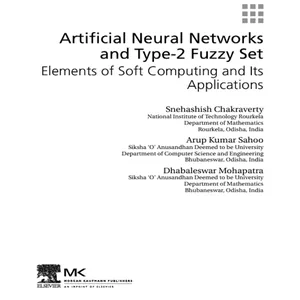
Description
Artificial Neural Networks and Type-2 Fuzzy Sets explores the fundamental concepts and latest research in various types of artificial neural networks (ANNs) and scientific machine learning. The main focus of the book is on combining these networks with type-2 fuzzy sets (T2FS) to create more intelligent systems that are more robust to environmental uncertainties.
The authors provide practical examples and a variety of case studies to teach how to solve complex engineering and basic science problems in both static and dynamic situations. This book is recognized as the first reference to present the simultaneous application of neural networks and type 2 fuzzy logic in a single, coherent format to solve real-world challenges.
Book Features
- Comprehensive coverage of soft computing concepts with a focus on machine learning and advanced fuzzy logic.
- Investigating the integration of ANN and T2FS to increase the stability and accuracy of intelligent systems.
- Providing practical solutions for solving static and dynamic problems in science and engineering.
- Validation of the presented models through comparison with existing numerical and analytical solutions.
- Suitable for AI researchers who deal with ambiguous and noisy data.
Book specifications
- Publisher: Elsevier
- Teacher: Snehashish Chakraverty
- Number of pages: 243
- Number of chapters: 15
- Format: PDF
Headlines

Pictures

User Guide
Extract the file and run it with the appropriate software.
Download link
File(s) password: www.downloadly.ir
File size
23 MB