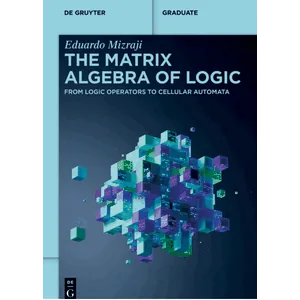
Description
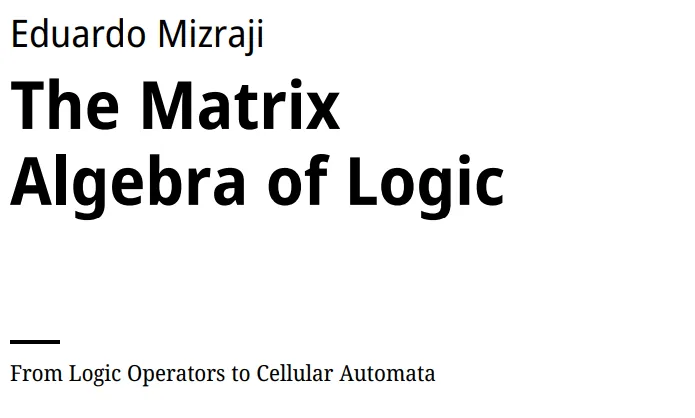
The Matrix Algebra of Logic explores the fundamental role of matrix algebra in emerging theories such as quantum computing and neural models that underpin generative artificial intelligence. Taking a fresh look at the analysis of logical operations through matrices, the author introduces an approach that bridges traditional concepts of logic with modern mathematical tools.
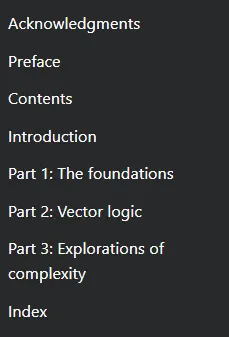
In this work, the author shows how matrix algebra can provide a simple process for addressing complex topics in basic logic and multivalued logics. Sections of the book are also devoted to “cellular automata,” which are recognized as a model for understanding complex behavior in natural systems.
Book Features
- Providing matrix formulations for logical and arithmetic operators.
- Investigating the application of linear algebra in modeling biological and artificial neural networks.
- In-depth analysis of cellular automata and their role in the automatic organization of systems.
- Relating the concepts of classical logic to the needs of modern quantum computing.
- Suitable for researchers in the fields of applied mathematics, computer science, and philosophy of logic.
Book specifications
- Publisher: De Gruyter
- Instructor/Author: Eduardo Mizraji
- Number of pages: 139
- Number of seasons: 3
- Format: PDF
Headings The Matrix Algebra of Logic

Pictures

User Guide
Extract the file and run it with the appropriate software.
Download link
File(s) password: www.downloadly.ir
File size
4.4 MB