Description
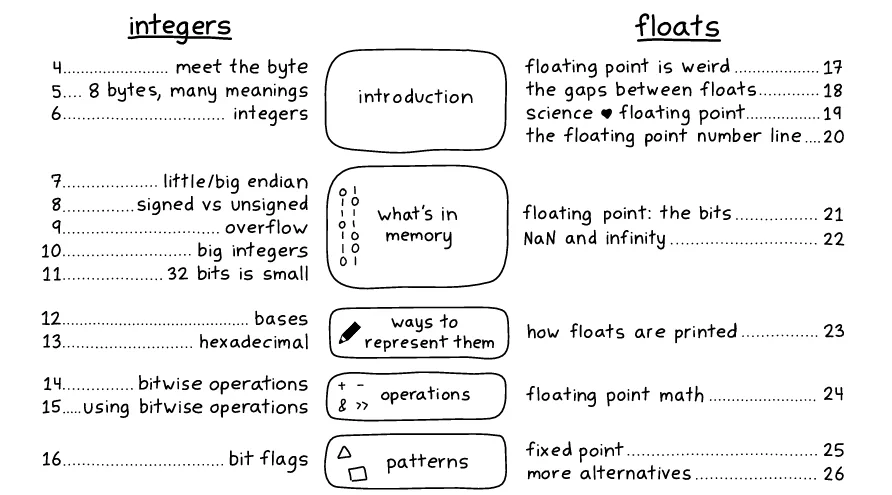
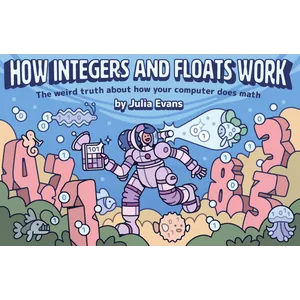
How Integers and Floats Work (Wizard Zines) by Julia Evans takes a different approach and uses attractive illustrations (Zines) to explore the basic but complex concepts of integers and floats in the computer world. The author attempts to dissect why numbers behave strangely in programming, such as integer overflows or imprecision in decimal calculations (for example, why the sum of 0.1 and 0.2 does not equal exactly 0.3), in a very simple and visual way for the audience.
The book is based on the idea that understanding how numbers are stored in memory is an essential skill for any programmer to avoid common computational errors. The material is presented in a way that turns the dry concepts of computer engineering into an enjoyable experience, helping the reader understand what goes on behind the scenes of processors when they work with bits and bytes.
Book Features
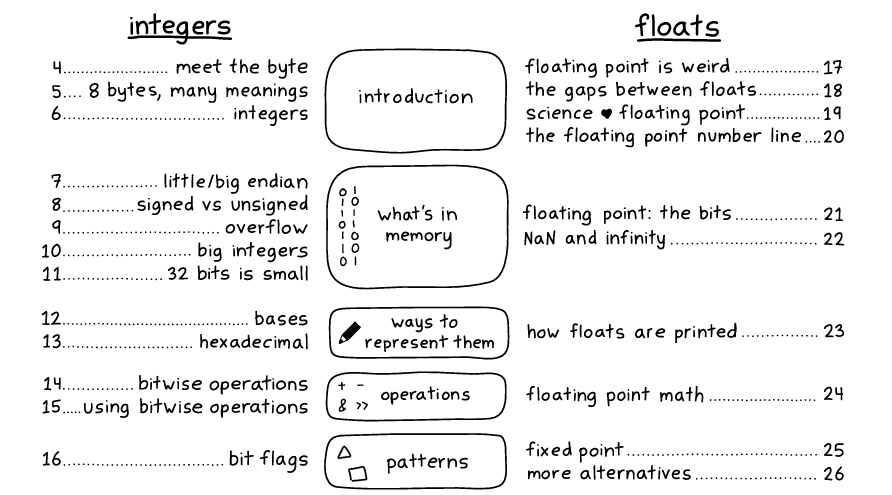
- Learning the differences between signed and unsigned integers (Signed vs Unsigned).
- A detailed examination of the binary and hexadecimal number systems and how they are represented in memory.
- Explain the concept of “Little-endian” and “Big-endian” in byte ordering.
- Analysis of the IEEE 754 standard and how floating point numbers work.
- Providing alternative solutions for decimal calculations in sensitive financial and scientific cases.
- Using humorous tone and graphic images to facilitate learning of difficult concepts.
Book specifications
- Publisher: Julia Evans
- Instructor: Julia Evans
- Number of pages: 28
- Format: PDF
Headlines
Pictures

User Guide
Extract the file and run it with the appropriate software.
Download link
File(s) password: www.downloadly.ir
File size
13.5 MB