
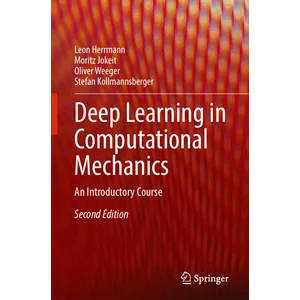
Description
Deep Learning in Computational Mechanics is intended for students, engineers, and researchers interested in the convergence of computational mechanics and deep learning. The main goal of this book is to introduce the mathematical and computational foundations of deep learning in an understandable way, accompanied by precise mathematical formulas, so that mechanics professionals can harness the power of neural networks in their work. This book attempts to fill an important scientific gap and integrate traditional models of classical mechanics with data-driven approaches.
In this book, the authors describe the diverse applications of deep learning in computational mechanics, while also providing detailed explanations of the fundamental principles of related computational mechanics. This dual approach allows engineers with less experience in the field of deep learning to understand its core concepts, such as neural networks and various architectures, in the context of mechanical problems. The book also discusses concrete applications, such as approximate modeling of stress-strain relationships and prediction of deformation under loading.
Book Features
- Presenting the mathematical and computational foundations of deep learning with precise formulas.
- Includes sample programs (such as Jupyter notebooks or Python files) for hands-on practice.
- Exploring applications of deep learning in computational mechanics, including surrogate modeling and acceleration of simulations.
- Provide sufficient explanations of the fundamental principles of computational mechanics to establish conceptual integration.
- Designed for students, engineers, and researchers working at the intersection of these two disciplines.
Book specifications
- Publisher: Springer
- Lecturer: Stefan Kollmannsberger
- Number of pages: 489
- Number of chapters: 9
- Format: PDF
Headlines
- Computational mechanics meets artificial intelligence
- Fundamental concepts of machine learning
- Neural networks
- Introduction to physics-informed neural networks
- Advanced physics-informed neural networks
- Machine learning in computational mechanics
- Material modeling with neural networks
- Generative artificial intelligence
- Inverse problems and deep learning
Pictures

User Guide
Extract the file and run it with the appropriate software.
Download link
Download Springer – Deep Learning in Computational Mechanics, Second Edition 2025
File(s) password: www.downloadly.ir
File size
26 MB