Description
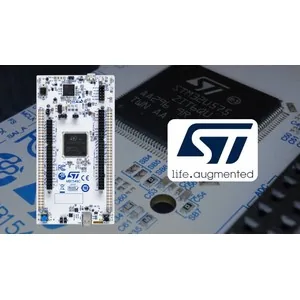
Getting started with STM32 MCUs programming course. This course explores how to program STM32 microcontrollers using the STM32Cube ecosystem and work with various hardware for embedded systems projects. STM32 microcontrollers are among the most widely used electronic components in various fields such as consumer appliances, automotive industry, medical equipment and Internet of Things (IoT). These microcontrollers are very powerful due to their architecture based on ARM Cortex-M cores, while at the same time having very low power consumption. This course guides participants step by step on the path to mastering STM32 microcontrollers. Along the way, it takes advantage of the STM32Cube ecosystem, a set of free software tools and libraries provided by ST Microelectronics. The ultimate goal is for learners to quickly achieve sufficient independence to carry out their own projects. This course teaches you how to configure and use the main peripherals and communication interfaces through hands-on projects on the Nucleo board (a cost-effective development board that is also compatible with Arduino shields). Concepts such as UART, I2C, SPI, timers, and DMA are covered in this section. For this purpose, the powerful STM32CubeMX tool is used to graphically configure the hardware and generate initial code. The ST HAL library is also used to facilitate and accelerate the development process. This training is based on the new workflow in the STM32CubeIDE v2 version (available in late 2025), in which the STM32CubeMX tool is used as a standalone program. Theoretical lessons also fully explain concepts such as internal architecture, interrupts, and communication buses.
What you will learn
- Introduction to STM32 microcontrollers and the STM32Cube software ecosystem.
- Working with STM32CubeIDE and STM32CubeMX tools for project development.
- How to configure various hardware components using a graphical interface.
- Managing and working with interrupts in system programming.
- Using the DMA system to transfer data directly between memory and peripherals.
- Uses the most common communication interfaces including UART (serial port), I2C, and SPI.
- Use peripherals in different blocking (Polling), interrupt, and DMA modes.
- How to search and extract the required technical information from official ST company documentation.
- Generating optimized codes for power management and increasing processor efficiency.
This course is suitable for people who:
- Electronic and computer engineers who want to improve their skills in the field of embedded systems.
- Students who are taking courses related to microcontrollers or doing final projects.
- Hobbyists who want to go beyond simple boards and work with professional tools.
- C programmers who want to enter the world of hardware programming and real equipment control.
- Internet of Things (IoT) professionals looking for powerful, low-power platforms for their products.
Course details Getting started with STM32 MCUs programming
- Publisher: Udemy
- Instructor: Matthieu Zimmermann
- Training level: Beginner to advanced
- Training duration: 5 hours and 30 minutes
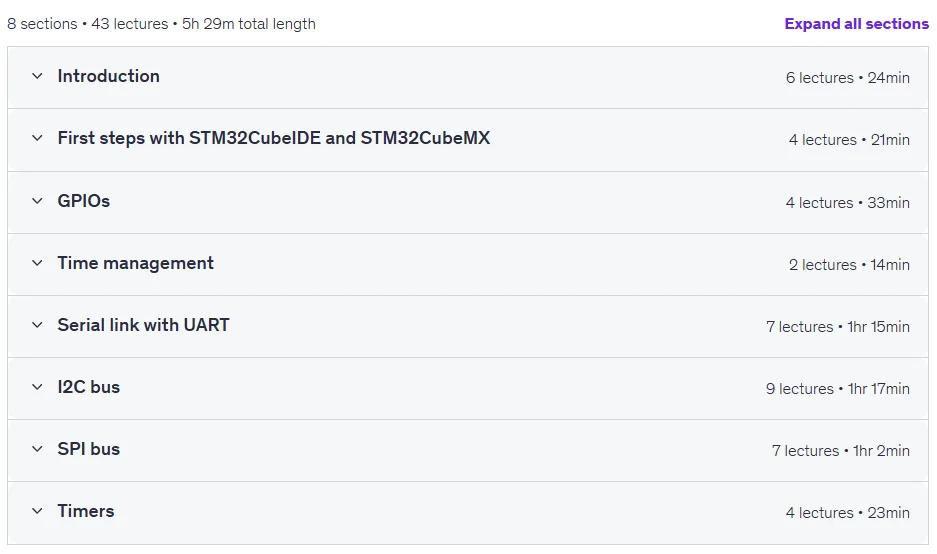
Course syllabus as of 2026/1

Prerequisites for the Getting started with STM32 MCUs programming course
- At least a basic knowledge of C programming language
Course images
Sample course video
Installation Guide
After Extract, view with your favorite player.
Subtitles: None
Quality: 1080p
Download link
Downloadly
Rapidgator link
File(s) password: www.downloadly.ir
File size
2.0 GB