
Description
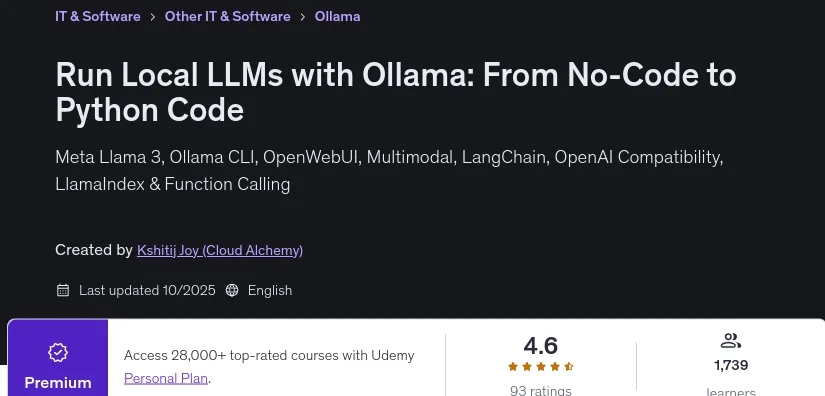
Run Local LLMs with Ollama: From No-Code to Python Code. This course teaches how to work with language models like Meta Llama through the user-friendly Ollama platform. The course uses the Llama model as the main example, but the techniques presented can also be applied to other open-source models such as DeepSeq and Qone. The course content starts at an introductory level and covers working with language models step-by-step, both through no-code tools and using Python programming. Participants first learn the basic concepts and features of the Llama 3 model, then work hands-on with installing, configuring, and fine-tuning the model for real-world applications. This comprehensive approach enables learners to confidently use large language models in their own practical projects and develop AI-based solutions upon completion of the course.
What you will learn
- Fundamentals of Artificial Intelligence and LLM:
- Introduction to Artificial Intelligence (AI), Neural Networks, and LLM principles.
- Understand the differences between AI vs. ML vs. DL (machine learning vs. deep learning).
- Concepts of Billion Parameters, Model Benchmarks, Transformers, Embedding, and Quantization.
- Introducing Meta LLaMA:
- Introduction to Meta LLaMA 3.2/3.3 and the history of LLaMA.
- Differences between LLaMA and other LLMs such as GPT.
- How LLaMA processes text: Tokens, Embeddings, and Attention Mechanisms.
- Deployment and Ollama Strategies:
- Model deployment strategies with Hugging Face, PyTorch, Ollama, and Azure, along with demos.
- In-depth introduction to Ollama, its benefits and uses.
- Installing Ollama on Linux, Mac and Docker mode.
- Demos on Ollama CLI (Command Line Interface) commands.
- Custom model and user interface creation:
- Building the first custom model with Ollama and LLaMA.
- OpenWebUI, a graphical user interface (GUI) for Ollama models.
- Applications and integration with Python:
- How to use simple Python code in Ollama and create embeddings in Ollama.
- Using Ollama with various IDEs like VSCode, Google Colab, and Jupyter Notebook along with demos.
- Multimodality capabilities – image analysis.
- LangChain with Ollama and LLaMA – Introduction to the concept of chaining.
- Ollama compatibility with OpenAI.
- Structured Outputs.
- Tools in LLaMA and Ollama – Function Calling.
This course is suitable for people who:
- Beginners in the field of Generative AI.
- Beginners in the field of Meta LLaMA.
- Beginners in the field of Ollama.
- Enthusiasts who wish to learn Ollama with LLaMA.
- Professionals who want to understand and view demos about the Ollama Python library.
- Beginners eager to explore artificial intelligence without prior experience.
- Technology enthusiasts who want to understand and use advanced artificial intelligence models.
- Developers who intend to integrate artificial intelligence into their personal or professional projects.
Course details
- Publisher : Udemy
- Teacher : Kshitij Joy (Cloud Alchemy)
- Language: English
- Level : All Levels
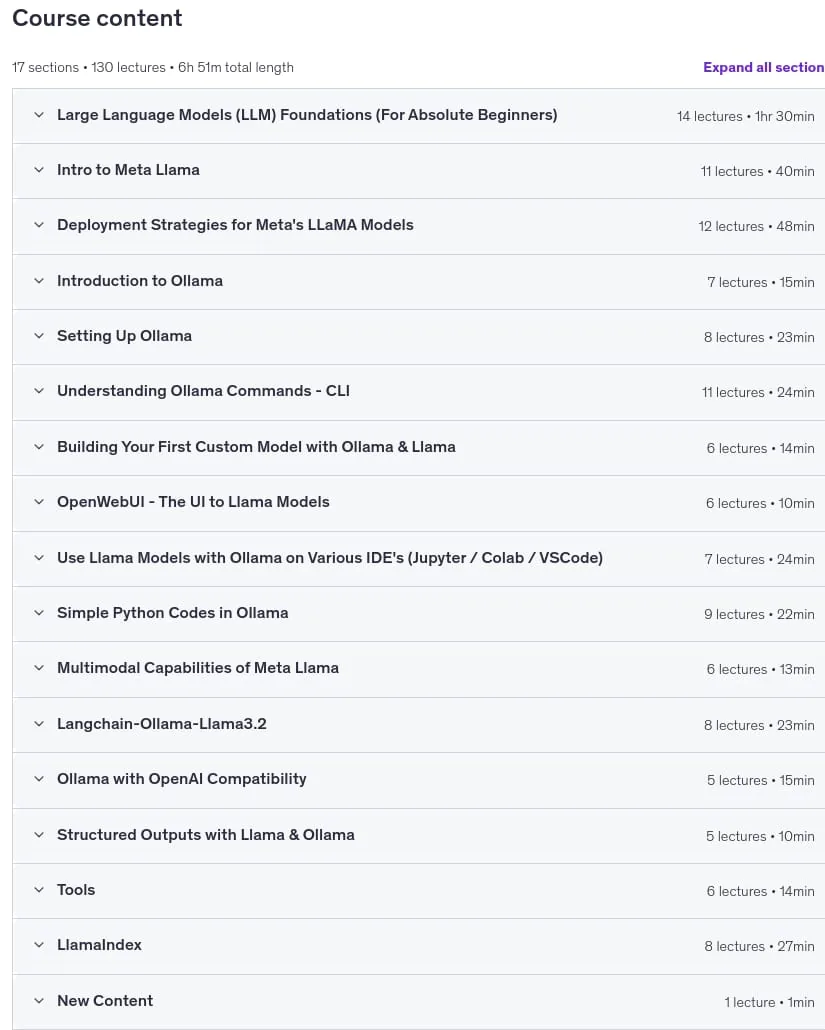
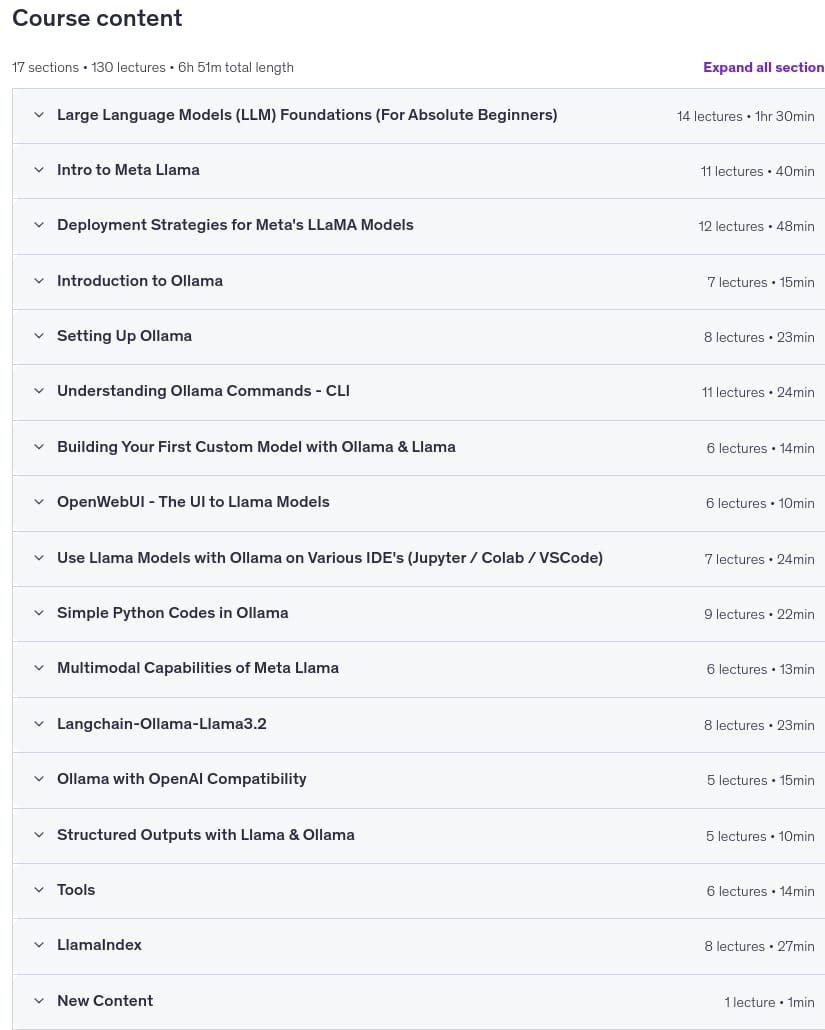
- Lectures : 130
- Duration : 6 hours and 51 minutes
Course syllabus
Prerequisites for the Run Local LLMs with Ollama: From No-Code to Python Code course
- No programming experience needed, we cover No-Code and Low-Code Approach
Course images

Sample course video
Installation Guide
After Extract, view with your favorite player.
Subtitles: English
Quality: 720p
The 2025/10 version has increased the number of lessons by 13 and the duration increased by 28 minutes compared to 2025/1.
Download link
File(s) password: www.downloadly.ir
File size
3.38 GB