
Description
IPSEC VPN Tunnel on MikroTik Course. This course on MikroTik provides a comprehensive mix of theoretical foundations and practical exercises, fully explaining how the IPSEC protocol works and how to configure it on MikroTik routers. As a widespread and widely used protocol framework, IPSEC enables secure connectivity of different branches of an organization over the public Internet and is a cost-effective alternative to expensive dedicated pipelines. However, its correct configuration is complex due to the presence of multiple subprotocols and phases. This course, dedicating a large part to theory, thoroughly explains all components of IPSEC, including basic security concepts such as encryption, hashing, authentication, and Diffie-Hellman key exchange. Following this, and after mastering the basics, practical workshops are held in which the implementation of both IKEv1 and IKEv2 versions on Mikrotik routers is objectively taught and tested to ensure correct performance.
What you will learn
- Understanding VPN and IPSEC Basics:
- Understanding what a VPN is.
- Understanding what IPSEC is.
- Understanding the four features of IPSEC.
- Understand why IPSEC is a protocol suite.
- Understand the protocols used in IPSEC features.
- IPSEC modes and functionality:
- Understanding IPSEC communication modes.
- Understanding Transport Mode in IPSEC.
- Understanding Tunnel Mode in IPSEC.
- Understanding the IPSEC negotiation process.
- Understand what an initiator is to start an IPSEC VPN.
- Understanding IPSEC negotiation protocols: AH vs. ESP.
- Security and encryption:
- Understanding Symmetric Key Encryption.
- Understanding Asymmetric Key Encryption.
- Understand how DH (Diffie-Hellman) works for secure secret key sharing.
- Understanding of cryptographic protocols such as: DES, 3DES, AES, Blowfish, Camellia, RSA, and DH.
- Understanding data integrity using hashing algorithms such as: MD5, SHA1, SHA256, SHA512.
- Understanding IPSEC authentication types: Pre-shared key vs. Certificate.
- IKE phases and practical configuration:
- Understanding IKE Phase 1 (ISAKMP).
- Understand the difference between Main Mode and Aggressive Mode in IKE Phase 1.
- Understanding IKE Phase 2.
- Understanding what a PFS (Perfect Forward Secrecy Group) is.
- Understanding the difference between IKEv1 and IKEv2.
- Configure Site-to-Site IPSEC using IKEv1.
- Configure Site-to-Site IPSEC using IKEv2.
- Configure IPSEC IKEv2 Remote Access using certificates.
This course is suitable for people who:
- Students who want to learn and understand how IPSEC works and know how to configure it in MikroTik RouterOS.
- Engineers who want to implement the IPSEC tunneling protocol in their networks.
Course details
- Publisher: Udemy
- Instructor: MA ICT BV
- Training level: Beginner to advanced
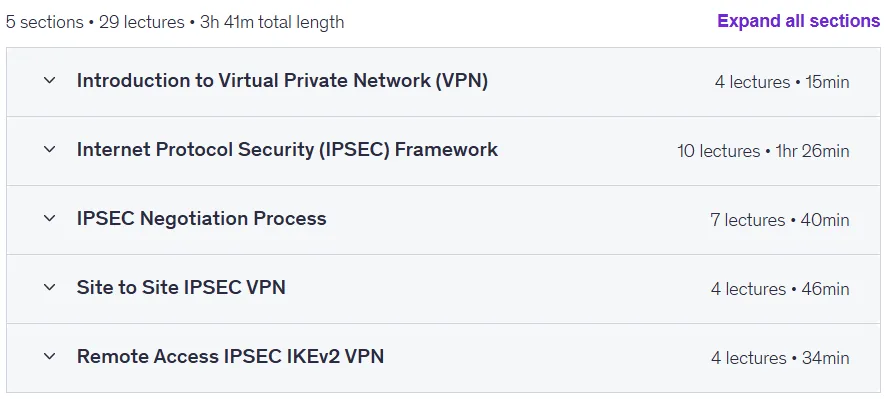
- Training duration: 3 hours and 41 minutes
- Number of lessons: 29
Course headings

Prerequisites for the IPSEC VPN Tunnel on MikroTik course
- Have a TCP/IP knowledge
- Have an experience with networking
- Ideally have an MTCNA certificate
Course images
Sample course video
Installation Guide
After Extract, view with your favorite player.
Subtitles: English
Quality: 720p
Download link
Downloadly
Rapidgator link
File(s) password: www.downloadly.ir
File size
1.7 GB