Descriptions
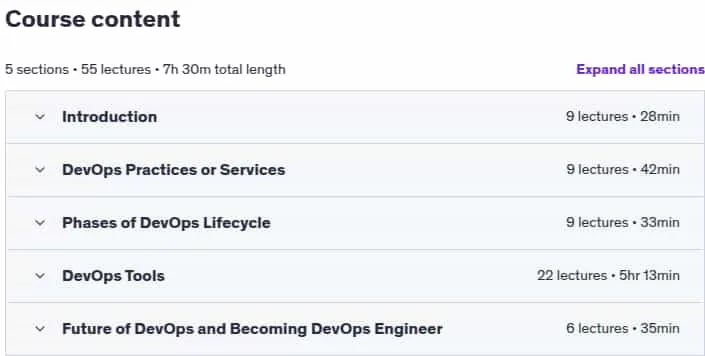
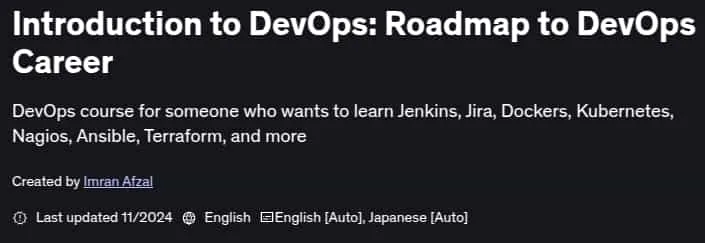
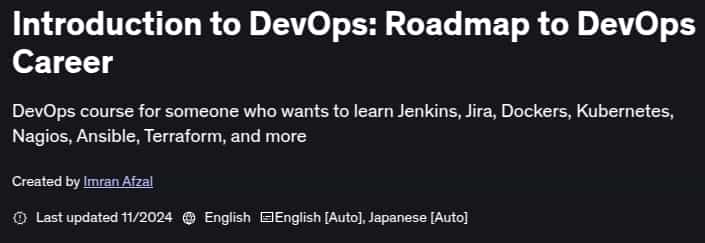
Introduction to DevOps: Roadmap to DevOps Career, This course is designed to introduce students to the fundamentals of DevOps, including its principles, practices, tools and most importantly, the future of DevOps and roadmap to become a DevOps Engineer. The course covers the essential concepts of continuous integration, continuous delivery and deployment (CI/CD), situational awareness, automation, infrastructure as a code, microservices, monitoring, logging and feedback, and collaboration. All phases of DevOps lifecycle are well explained. Moreover, you’ll learn about risk assessment, version control, unit testing, performance testing, quality assurance, incident management, application security management and much more.
You’ll learn more than 20 DevOps tools like Dynatrace, Nagios, Slack, Microsoft Teams (Communication), Splunk, Puppet, Chef, Ansible, Jenkins, Git, GitHub (Version Control), ServiceNow (Incident Management), Docker, Kubernetes, Terraform, Jira (Jira Product Discovery and Jira Software) etc. Last but not the least, section 5 will provide you with a road map to become DevOps Engineer even if you want a career change and switch to DevOps. Furthermore, you’ll learn about DevOps job responsibilities, job search and link building on LinkedIn and other job boards, resume and interview skills. You’ll also know whether remote work is available for DevOps Engineers or not. You will learn about all the tools used in DevOps environment such as Dynatrace, Nagios, Slack, Microsoft Teams (Communication), Splunk, Puppet, Chef, Ansible, Jenkins, Git, GitHub (Version Control), ServiceNow (Incident Management), Docker, Kubernetes, Terraform, Jira (Jira Product Discovery and Jira Software) and much more.
What you’ll learn
- You will learn the basic concept of DevOps, history and how it all began
- You will learn all the tools used in DevOps environment such as Docker, Anisble, Kubernetes, Terraform, Git, CI/CD etc.
- DevOps practices such as integration, situaltional awareness, automation, infrastructure as a code, Microservices, Colloaboration etc.
- Describe the available resources to learn or apply DevOps
- Pros and Cons of DevOps
- You’ll acquire effective communication skills and learn new ways of thinking, working, organizing, and measuring to fully gain the benefits of DevOps
- All the phases of DevOps lifecycle
- How to become DevOps Engineer, most demanding professionals, thrilling profession
Who this course is for
- IT Professionals: System Administrators, Network Administrators, and other IT personnel looking to transition into DevOps roles.
- Software Developers: Software Developers eager to understand the operational aspects of software deployment and maintenance.
- Quality Assurance Professionals: QA testing professionals and engineers interested in learning about continuous integration and continuous delivery (CI/CD) practices.
- Fresh Graduates and Students: Individuals in computer science, information technology, or related fields seeking practical knowledge in modern software development methodologies.
- Career Changers: Anyone looking for a career change towards the rapidly growing field of DevOps.
- Technical Support Engineers: IT Support personnel wanting to broaden their skills in software deployment and management.
Specificatoin of Introduction to DevOps: Roadmap to DevOps Career
- Publisher : Udemy
- Teacher : Imran Afzal
- Language : English
- Level : All Levels
- Number of Course : 55
- Duration : 7 hours and 30 minutes
Content of Introduction to DevOps: Roadmap to DevOps Career

Requirements
- Desire to learn Devops
- Basic knowledge of software development principles and practices is recommended but not required.
- This course is suitable for IT professionals, software developers, QA professionals, fresh graduates, and anyone looking to transition into a DevOps role.
Pictures
Sample Clip
Installation Guide
Extract the files and watch with your favorite player
Subtitle : English
Quality: 720
Download Links
Password file(s): www.downloadly.ir
File size
2.21 GB